Heidelberg-Thessaloniki-Garching collaboration - Neutron-star radius constraints
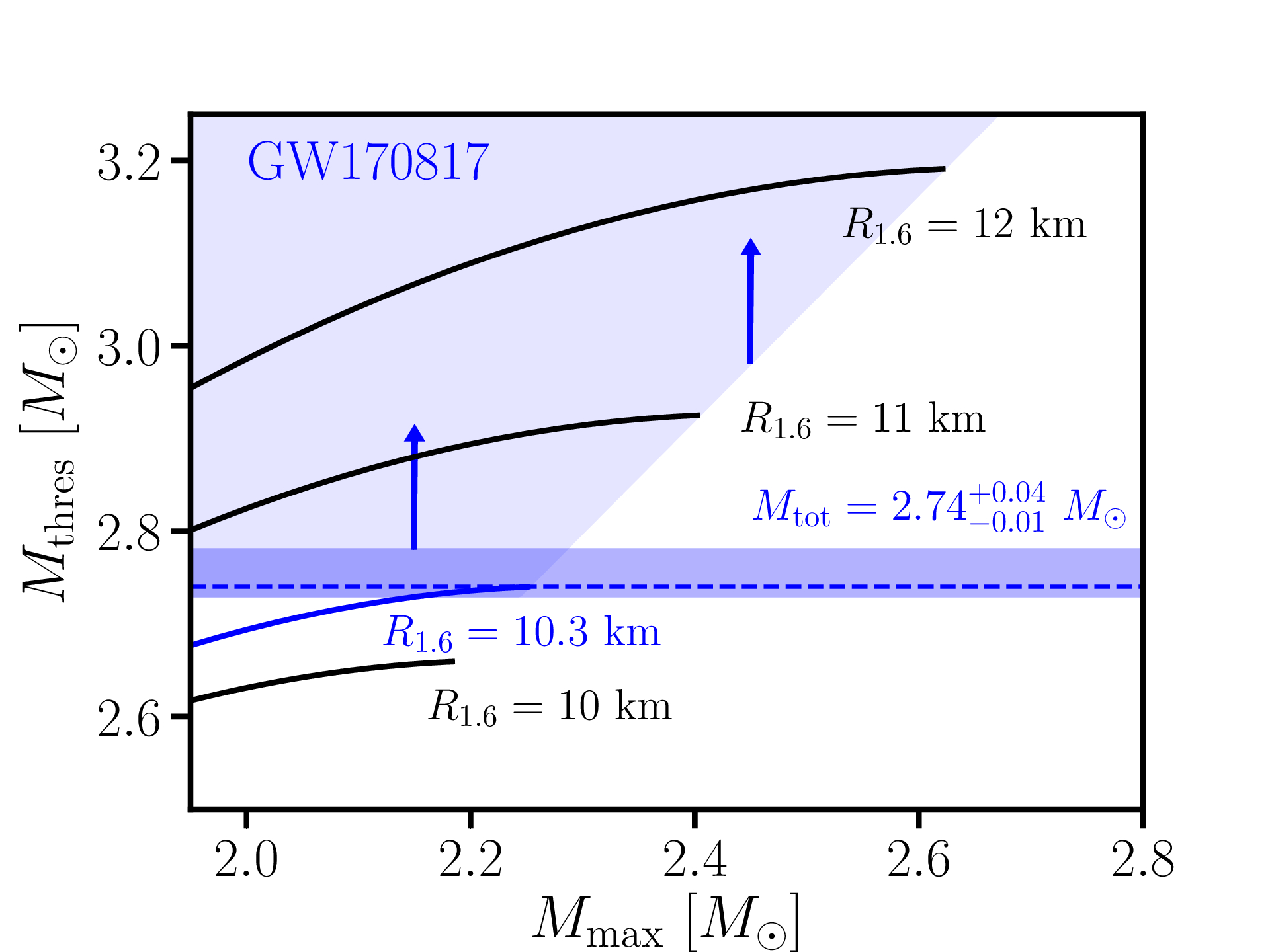
On this website we will provide updated neutron-star radius constraints following this method, which is based on detections of neutron-star mergers. Our method is based on the binary mass measurement of GW events and the distinction between a prompt or delayed gravitational collapse in this event, e.g. through electromagnetic observations.
We intend to provide a platform that collects studies contributing to the interpretation of these events and in particular their collapse behavior. Please help us updating this discussion by pointing us to references arguing either in favor or against a prompt collapse in a given event. (Neutral papers with valuable information on the collapse scenario are welcome as well.) Please send your suggestion to A. Bauswein (andreas.bauswein at h-its.org).
GW170817:
Favoring a delayed or no collapse in GW170817:
• Bauswein, Just, Janka, Stergioulas. Neutron-star radius constraints from GW170817 and future detections, submitted to ApJL, arXiv:1710.06843
• ...
• ...
Disfavoring a delayed collapse in GW170817:
• ...
If GW170817 resulted in a delayed or no collapse, neutron star radii are constraint through GW170817's binary mass, which provides a lower limit on the threshold binary mass for prompt black hole formation (see Bauswein et al. 2017).